
As the new academic year approaches, parents across Arlington are busy filling backpacks, buying school supplies, and organizing sports physicals. However, one essential item on your back-to-school checklist often goes overlooked: a thorough, doctor-led pediatric eye exam. Academic success is deeply tied to how effectively a student's visual system processes information in the classroom. While standard school vision screenings offer a helpful baseline, they frequently miss subtle functional vision issues that can make reading and focusing far more difficult than they need to be.
At Eye See Optique Arlington, our expert optometric team prioritizes comprehensive visual care that goes beyond basic distance checks. By identifying and addressing hidden visual barriers before the semester is in full swing, we provide your child with the specialized care and foundation they need to read with ease, maintain focus, and excel throughout the school year.
Why School Vision Screenings Are Not Enough for Classroom Success
School vision screenings primarily test distance visual acuity, missing complex functional visual skills like eye tracking, focusing agility, and binocular teamwork that are essential for reading and learning.
Many parents assume that if their child passes a basic vision screening at school or at the pediatrician's office, their eyes are completely healthy. However, a screening is only designed to catch severe distance vision problems, such as big shifts in nearsightedness. It does not measure how hard a student's eyes have to work when reading a book, copying notes from a board, or sitting in front of a computer screen for six hours a day.
Roughly 80% of all learning in a typical classroom environment is visual. When a student sits down to read, their eyes do not simply stand still. They must make fast, precise jumps from word to word across the page. They also need to clear their focus instantly when looking up at a presentation board and back down to a notebook. When these functional skills are out of sync, a child with perfect 20/20 distance vision can still experience severe visual strain, confusion, and fatigue.
20/20 Vision vs. Ocular Endurance: What Every Parent Should Know
20/20 vision simply measures how clearly a child sees letters on a static wall chart at 20 feet, whereas ocular endurance measures how comfortably and accurately their visual system performs over continuous hours of classroom work.
When our doctors evaluate a child at Eye See Optique Arlington, we look at the complete visual system to ensure your student has the stamina required for modern learning. We evaluate three critical functional areas:
- Eye Tracking and Movement: The ability to move the eyes smoothly across a printed line or follow a moving object across a screen without losing place or skipping lines.
- Focusing Agility (Accommodation): The capacity to change focus quickly and effortlessly between near work on a desk and distance viewing at the front of the classroom.
- Binocular Alignment and Teaming: How accurately both eyes work together as a coordinated team to create a single, clear, three-dimensional image without causing double vision or spatial exhaustion.
When a child lacks functional ocular endurance, their brain has to put double the energy into just keeping text single and clear. That extra effort steals energy away from reading comprehension, memory retention, and overall attention span.
Recognizing the Subtle Signs of Student Vision Strain
Children rarely complain about vision issues directly because they assume everyone sees the world the way they do; instead, visual strain usually shows up as behavioral frustrations or reading avoidance.
When a student struggles to focus in class or takes hours to complete short homework assignments, vision problems are often at the root of the issue. When a student comes to us struggling to keep their place on a page, parents are often surprised to learn that an undetected eye coordination issue was driving their child's frustration.
Watch for these common behavioral indicators in your child as the school year gets underway:
- Holding reading materials or tablet screens unusually close to the face.
- Frequent eye rubbing, excessive blinking, or squinting while reading or working at a computer.
- Covering or closing one eye to focus on close-up work.
- Losing their place frequently, skipping lines of text, or using a finger to guide their eyes across a page.
- Complaining of frequent afternoon headaches, sore eyes, or tiredness after school.
- Avoiding reading, drawing, or other detailed close-up tasks altogether.
What Happens During a Comprehensive Pediatric Eye Exam?
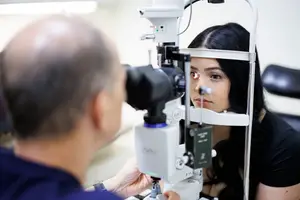
A comprehensive pediatric eye exam at Eye See Optique Arlington evaluates internal and external eye health, refractive errors, and functional visual processing using advanced, child-friendly diagnostic technology.
Our clinical approach at Eye See Optique Arlington is rooted in evidence-based optometry, ensuring every student receives precise diagnostic care tailored to their unique development. Unlike a quick visual screening, a full medical eye exam with our eye care team includes:
- Comprehensive Refraction: Checking for subtle amounts of nearsightedness, farsightedness, or astigmatism that can cause blur or subtle fatigue.
- Binocular Vision Testing: Evaluating how well your child's eyes work together, align, and focus during prolonged reading tasks.
- Ocular Surface and Internal Eye Health Checks: Examining the cornea, lens, retina, and optic nerve to safeguard long-term eye health against systemic or early visual issues.
- Personalized Solutions: Customizing recommendations, from specialized anti-fatigue spectacle lenses to targeted guidance for computer use and sports safety.
Schedule Your Child's Back-to-School Eye Exam in Arlington, Virginia
Securing your student's visual performance early in the school year helps prevent academic frustration and builds confidence in the classroom. Partnering with a dedicated local eye doctor is the most reliable way to maintain your family's long-term visual health.
Our team at Eye See Optique Arlington is proud to serve families in Arlington and the surrounding Penrose community. If you are ready to give your student the visual tools they need to read comfortably and succeed this year, we invite you to schedule a comprehensive pediatric eye exam with our experienced team today. You can also get directions to our Arlington office to plan your visit.
Frequently Asked Questions About Student Eye Exams
How often should students get a comprehensive eye exam?
- Students should have a comprehensive eye exam once every year before the school year starts. Because a child's eyes grow and change rapidly, annual exams ensure that prescription updates and visual tracking development stay aligned with their academic demands.
How is a pediatric eye exam different from a school vision screening?
- A school vision screening only tests distance visual acuity (ability to see letters on a wall chart). A pediatric eye exam evaluated by an eye doctor tests visual tracking, eye teaming, depth perception, focusing agility, and overall internal and external eye health.
Can undetected vision problems mimic learning difficulties like ADHD or dyslexia?
- Yes. Children with visual tracking or binocular vision issues often fidget, lose focus during reading, or avoid homework because of physical discomfort. These behaviors frequently resemble attention or reading difficulties, making functional eye exams a crucial first step in evaluating classroom struggles.
What should my child bring to their back-to-school eye exam?
- Please bring your child's current eyeglasses or contact lenses, a list of any current medications, and any observations or notes from teachers regarding their reading performance or classroom attention.